

Car Donation Terms Explained: A Simple Glossary for Vehicle Donors
Donating your vehicle to Wheels For Wishes is one of the simplest ways to help grant a life-changing wish for a child facing critical illness. The process comes with terminology that can feel unfamiliar, so this glossary explains every car donation term you are likely to encounter in plain language.
Ready to get started? Call 1-855-278-9474 or fill out our online donation form today.
Tax Terms
Fair Market Value (FMV)
The price a willing buyer would pay a willing seller for a vehicle when neither is under pressure and both have reasonable knowledge of the facts. FMV matters most when your vehicle sells for $500 or less at auction, since in that case you can generally claim its fair market value up to $500. Get the full breakdown of how car donation tax deductions work under current IRS rules.
Gross Proceeds
The total amount your donated vehicle sells for at auction. For vehicles that sell for more than $500, your tax deduction is based on the gross proceeds, the actual sale price your vehicle achieved, not an estimate. This is the figure that appears on IRS Form 1098-C.
IRS Form 1098-C
IRS Form 1098-C is the form specifically designed for donations of motor vehicles, boats, and airplanes. We file this on your behalf and mail you Copy B within 30 days of your vehicle's sale, provided it sold for more than $500 and you have supplied your Social Security Number. Attach it to your tax return when claiming your deduction.
IRS Form 8283
The IRS form for reporting noncash charitable contributions. You must file it if your total deduction for all noncash contributions exceeds $500 for the year.
For vehicle donations, the IRS designates donated vehicles as Section A items at every value, including deductions above $5,000, provided you have a contemporaneous written acknowledgment such as Form 1098-C. Section B, which requires a qualified appraisal, only applies if you pursue the separate appraisal route rather than our standard process. Consult a tax professional for guidance on your specific situation.
Tax-Deductible Receipt
The documentation you receive confirming your donation and establishing the value of your tax deduction. You receive a preliminary receipt shortly after pickup and, if your vehicle sells for more than $500, a final receipt reflecting the actual sale price. Keep both with your tax records. See how Wheels For Wishes maximizes your vehicle's value and your resulting tax receipt.
Preliminary Tax Receipt
The initial receipt mailed or emailed to you after your vehicle is confirmed as picked up. It serves as proof of donation and is sufficient for tax purposes if your vehicle sells for $500 or less. If it sells for more, a follow-up receipt reflecting the actual sale price is sent separately along with IRS Form 1098-C.
Tax Write-Off
The informal term for your tax deduction. When you donate to Wheels For Wishes, the auction sale price of your vehicle becomes your tax write-off, subject to IRS rules and only if you itemize. Vehicles selling for $500 or less allow a write-off of up to fair market value, up to $500. Vehicles selling for more than $500 allow a write-off equal to the full sale price. Learn how to get the most out of your car donation tax write-off.
Tax Savings Calculator
Wheels For Wishes offers an online tool that helps you estimate the potential tax benefit of your vehicle donation before you commit. Your actual deduction will be the lesser of what your vehicle sells for at auction and its fair market value at the time of donation. The calculator provides a general estimate rather than a guaranteed figure. It's a useful starting point for understanding your potential savings. Try our tax savings donation calculator.
Itemized Deduction
A method of reducing your taxable income by listing individual deductible expenses on Schedule A of IRS Form 1040, rather than taking the standard deduction. Car donation tax deductions are only available to donors who itemize. If your total deductions do not exceed the standard deduction for your filing status, the donation's tax benefit may be limited. Consult a tax professional for advice specific to your situation.
Schedule A (IRS Form 1040)
The IRS schedule used to list itemized deductions on your federal tax return. Charitable contributions, including vehicle donations, are reported here. If you take the standard deduction instead of itemizing, you cannot claim a vehicle donation deduction on your federal return.
Social Security Number (Required for Form 1098-C)
The IRS requires us to collect your Social Security Number to issue Form 1098-C for vehicles that sell for more than $500. You will be asked to provide it after your vehicle is picked up and sold. Without it we cannot file the 1098-C, and you cannot claim the full sale price as your deduction. Our collection process is secure.
501(c)(3)
The section of the IRS tax code that designates an organization as a tax-exempt nonprofit. To claim a deduction for your vehicle donation, the receiving organization must hold current 501(c)(3) status. Car Donation Foundation d/b/a Wheels For Wishes is a federally registered 501(c)(3) nonprofit, EIN 26-3408048. You can verify our status through the IRS Tax Exempt Organization Search tool. Learn what makes Wheels For Wishes a legitimate and trustworthy program.
Written Acknowledgment
The IRS requires a written acknowledgment from the receiving organization for any charitable contribution of $250 or more. For vehicle donations, this is fulfilled by the tax receipt or Form 1098-C we send you. It must include your name, the vehicle description, the donation date, and a statement that no goods or services were provided in exchange. Read our full transparency page to see exactly how proceeds are handled and documented.
IRS Publication 4303
The IRS's official guide titled "A Donor's Guide to Car Donations." It outlines the rules for vehicle donation deductions, documentation requirements, and how deduction amounts are determined. It is the definitive IRS reference for anyone donating a vehicle to charity and is linked directly from our tax information page.
Title Terms
Vehicle Title (Certificate of Title)
The legal document proving you own your vehicle. It is the single most important piece of documentation in the donation process. Without a title in your name, ownership transfer cannot be completed in most states. It identifies the vehicle by VIN, make, model, year, and lists any lien holders. See exactly what you need and how the full donation process works.
Clear Title
A title free of liens, errors, alterations, and legal encumbrances. Most states require a clear title in your name to complete a donation. A title with cross-outs, white-out, or water damage may be considered void. Review our vehicle donation title FAQ for full guidance on title requirements.
Assignment of Title
The section of your title where you sign to legally transfer ownership. You sign as the seller and leave the buyer section blank; we complete that part. Never cross out or correct anything in this section, as any alteration voids the title. Our FAQ answers the most common title questions donors ask before donating.
Transferable Title
A title legally eligible to be signed over to another party. Active liens, errors or alterations, illegible information, or a title already signed over to someone else can all make a title non-transferable. See the types of vehicles and documentation we accept.
Duplicate Title
A replacement title from your state DMV when the original is lost, stolen, or damaged. Most states offer them online, in person, or by mail. Processing times range from a few days to several weeks. Call us while you wait and we will get you scheduled in advance.
Salvage Title
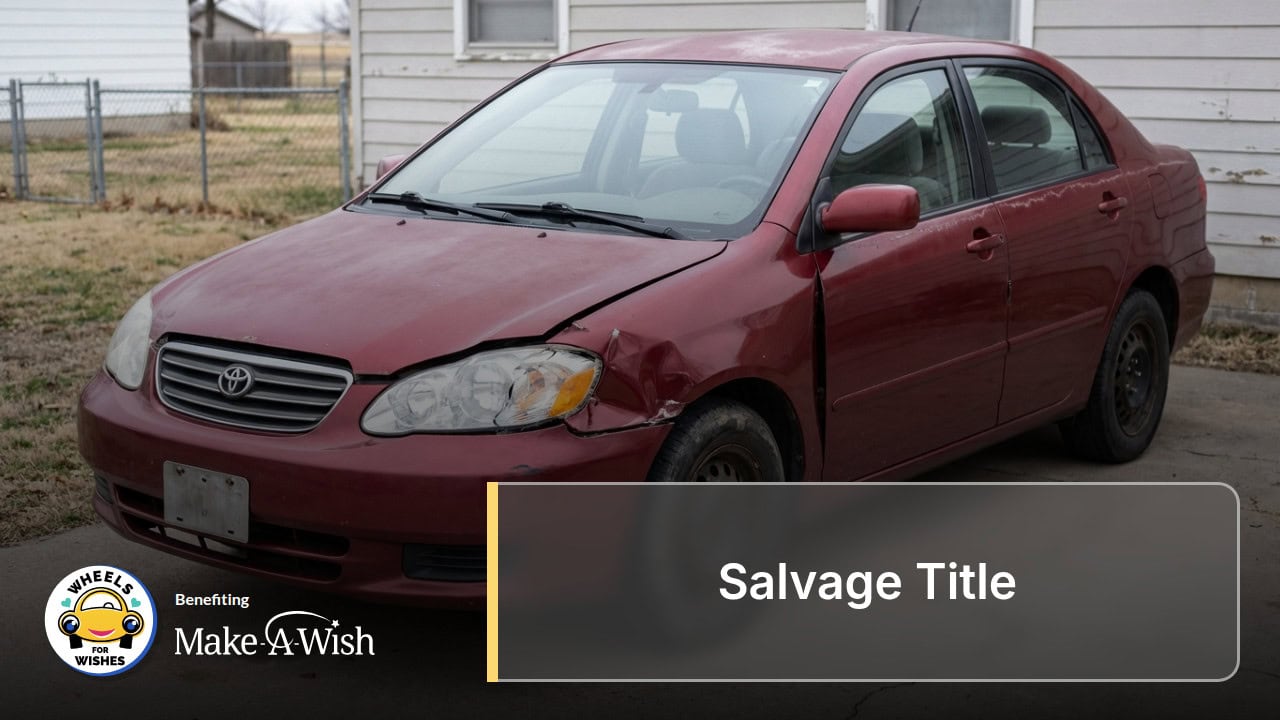
A title designation indicating a vehicle was declared a total loss by an insurance company. Vehicles with salvage titles may still qualify for donation on a case-by-case basis. See how older and salvage-titled vehicles can still make a difference for local wish kids.
Title Correction Form
A form from most state DMVs allowing title errors to be corrected without a full duplicate application, typically faster and cheaper. Common fixable errors include misspelled names and incorrect vehicle information. Never correct a title yourself by crossing out or writing over existing information, as that voids it.
Lien
A legal claim held by a lender against your vehicle as security for an outstanding loan. If a lien holder is listed on your title, the loan must be paid off and released before the vehicle can be donated. The lien holder's name appears on the front of your title in the legal owner section.
Lien Release
A document from your lender confirming a loan is paid off and the lender no longer holds a claim against the vehicle. It may arrive as a separate letter or as a stamp reading "LIEN RELEASED" on the title itself. Without it, a title showing a lien holder cannot be transferred. With your written authorization, we can often request lien releases from lenders on your behalf. See how to prepare your vehicle and complete all pre-donation requirements.
Notarized Signature
In certain states, your title signature must be witnessed and certified by a licensed notary public. Do not sign the title before visiting the notary. You must sign in their presence. Notaries are available at most banks, UPS stores, FedEx Office locations, and law offices. States currently requiring notarization include Arizona, Kentucky, Louisiana, Montana, Nebraska, North Carolina, Ohio, Oklahoma, Pennsylvania, and Wyoming. Requirements can change, so always confirm with our team before signing.
Release of Liability / Notice of Transfer
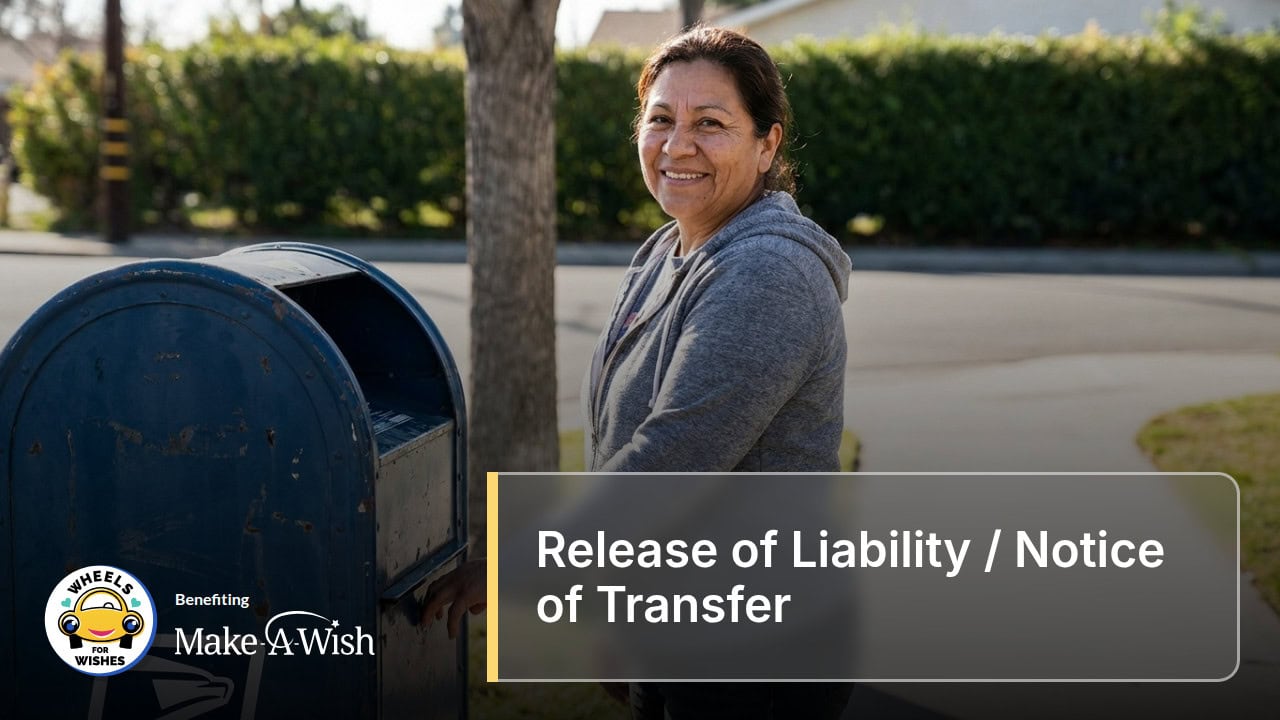
A filing submitted to your state DMV after pickup confirming ownership has transferred. This protects you from future parking tickets, tolls, violations, or registration fees tied to the vehicle after donation. Most states allow online filing, so you can complete it promptly. Required states include California, Colorado, Florida, Illinois, Iowa, Minnesota, Missouri, Oregon, Texas, Washington, and others.
Odometer Disclosure
A state-required disclosure of the vehicle's mileage at the time of transfer, recorded on the title or a separate statement. Federal law requires odometer disclosure for most vehicles under ten years old. We record the reading at pickup, so you typically do not need to complete this yourself.
Co-Owner / Joint Title
A title listing two owners. If names are joined by "and," both must sign. If joined by "or," either owner may sign alone. Rules for titles with no conjunction vary by state. Call us and we will confirm what yours requires.
Power of Attorney (POA)
A legal document authorizing one person to sign a vehicle title on behalf of another. The POA must specifically grant authority to sell or transfer vehicles, must be notarized in most states, and must be an original or certified copy. When signing under POA, sign both the owner's name and your own indicating your role. Example: "John Smith by Jane Smith, Attorney-in-Fact."
Deceased Owner Title Transfer
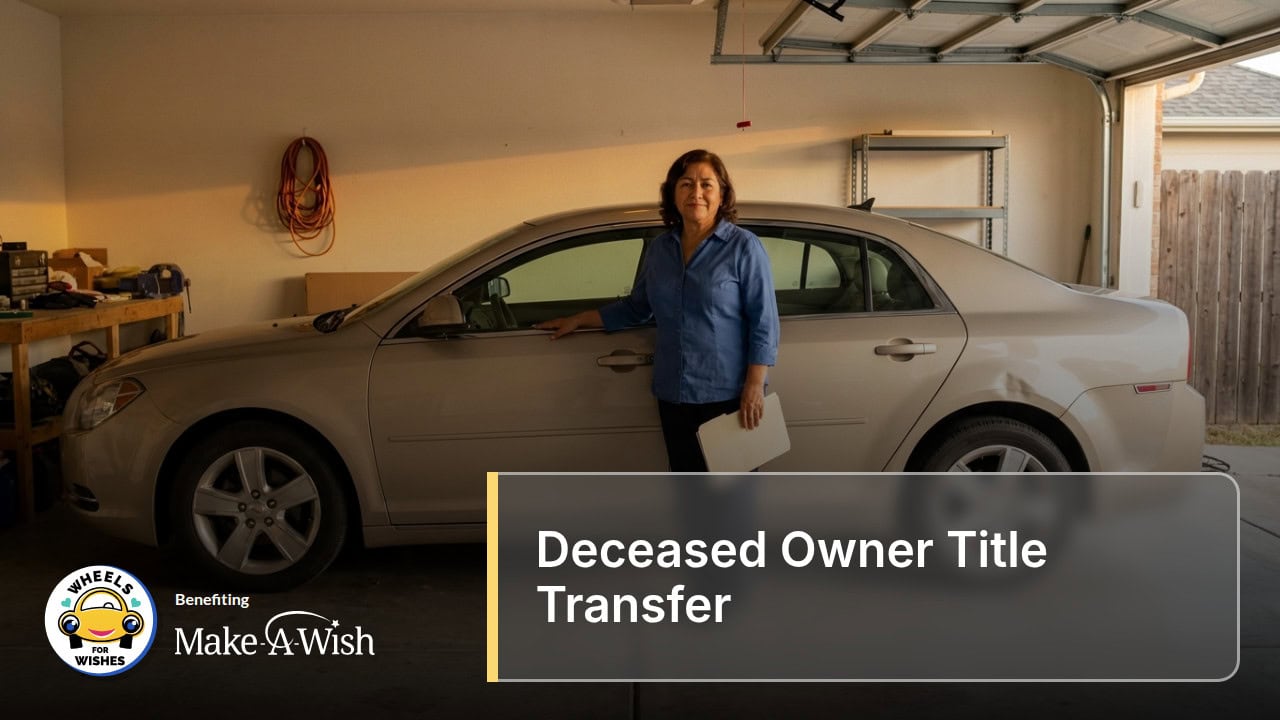
The process of donating a vehicle titled in the name of someone who has passed away. Requirements vary by state but generally include the original title, a certified death certificate, and executor paperwork. Call us and we will walk you through exactly what your state requires.
Letters Testamentary / Executor Rights
A court document issued during probate granting an executor legal authority to manage a deceased person's estate, including transferring vehicle titles. Also called Letters of Administration or Letters of Representation depending on the state. Typically required alongside the death certificate and original title when donating an estate vehicle. Call us at 1-855-278-9474 and we will explain what your state requires.
Process Terms
VIN (Vehicle Identification Number)
A unique 17-character code assigned to every motor vehicle, used to identify your specific vehicle throughout the donation process and on IRS documentation. Find your VIN on the driver's side dashboard visible through the windshield, on the door jamb sticker, or on your title and registration. You will need it when completing the donation form. Start your donation and have your VIN ready.
Case-by-Case Basis
The standard by which we evaluate each vehicle individually. Eligibility depends on condition, location, type, and whether the cost of processing is justified by the vehicle's likely value. Most vehicles in most conditions are accepted. When in doubt, call us for a straight answer.
Free Towing / Free Pickup
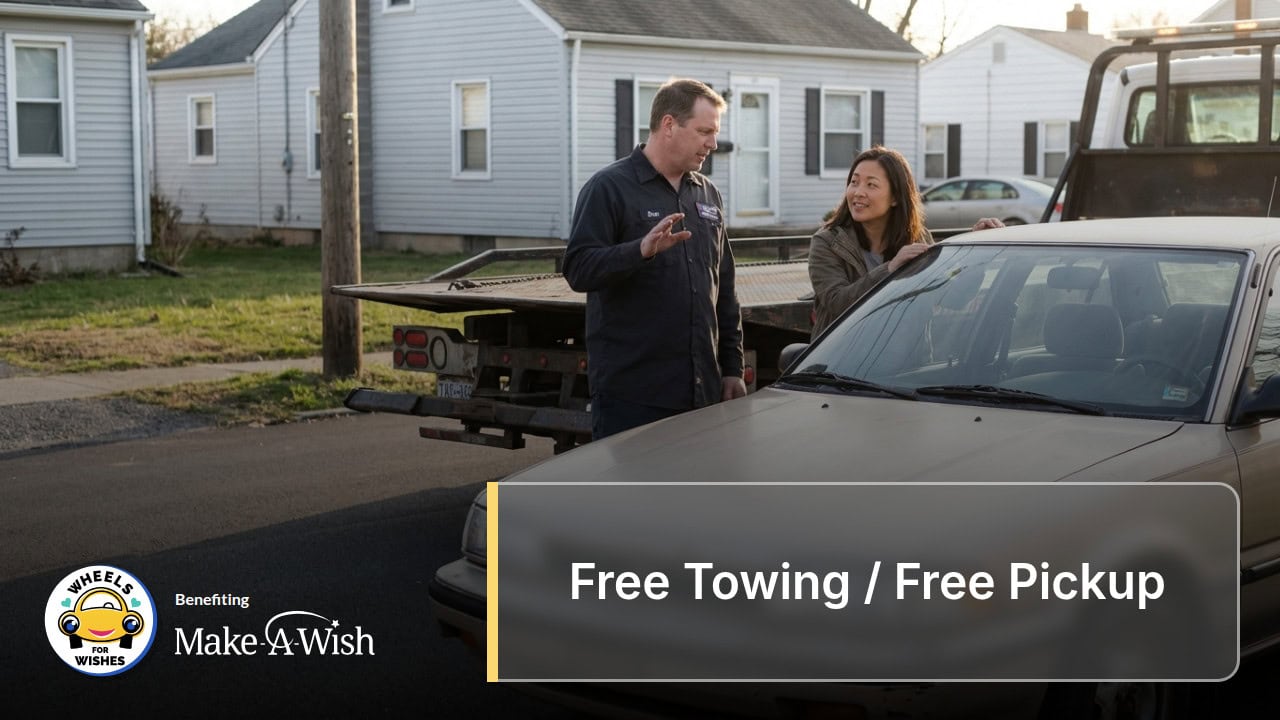
We arrange and cover the cost of towing your donated vehicle from anywhere in the United States, at no cost to you, whether it runs or not. You do not need to arrange transportation or deliver the vehicle anywhere. Instead, you'll receive a call to schedule your free towing at your convenience. See how we make the donation experience as easy as possible for every donor.
Pickup Window
The scheduled time period during which the towing company will arrive to collect your vehicle. Pickup windows are typically arranged within 24 hours of the next business day after you complete your donation, based on availability in your area and your scheduling preferences. You do not need to be present as long as the signed title and keys are accessible.
Tow Receipt / Donation Receipt
The document the tow driver provides at the time of pickup confirming your vehicle was received. It is your initial proof of donation and includes the date, vehicle description, and basic donor information. Keep it along with your final tax receipt, which arrives after the vehicle sells.
Auction
The primary channel through which donated vehicles are sold to generate proceeds for Make-A-Wish. Buyers bid competitively and the final hammer price becomes the gross proceeds that determine your tax deduction. Auction is the preferred path for vehicles with resale value because competitive bidding typically produces stronger results than direct sale. See how our experienced team works to get the most value from every donated vehicle.
Recycling / Scrap Value
When a vehicle cannot be resold at auction, it is processed through recycling. Steel, aluminum, and other materials carry real scrap market value. Even a non-running vehicle with no buyer generates real proceeds through recycling, and those proceeds still reach Make-A-Wish kids. Learn how non-running and high-mileage vehicles are still accepted and still make a difference.
Processing Partner
The third-party company we work with to tow, process, and sell donated vehicles. When you complete your donation, your vehicle is assigned to the nearest processing partner, who will contact you to schedule pickup. Processing partners operate the auction and recycling channels through which your vehicle is sold and are vetted to ensure vehicles are handled in a way that maximizes proceeds for Make-A-Wish.
Make-A-Wish Chapters

The local Make-A-Wish chapters that receive proceeds from your vehicle donation. Wheels For Wishes works with chapters across the country, meaning your donation benefits the kids closest to where your vehicle is donated. Proceeds fund life-changing wish experiences for children facing critical illness. Find the Make-A-Wish chapter your donation will benefit.
Wish
A life-changing experience granted by Make-A-Wish to a child facing a critical illness. Wishes vary widely: a trip to Disney World, meeting a favorite celebrity, a bedroom makeover, seeing the ocean for the first time. What they share is the ability to bring joy and hope to children and families navigating some of the hardest experiences imaginable. Your vehicle donation generates the proceeds that make these wishes possible. Read real wish stories and see the impact your donation makes.
Critical Illness
The eligibility criterion for a Make-A-Wish wish. Children older than 2½ and younger than 18 who have been diagnosed with a progressive, degenerative, or malignant condition that places their life in jeopardy may be eligible to have a wish granted. Though critical illness is not limited to cancer, cancer is the most common condition among wish children. Every vehicle donation to Wheels For Wishes contributes to the funding that allows Make-A-Wish to serve these children. Learn more about our program and the children your donation benefits.
Have a question about a term not covered here? Call 1-855-278-9474 or fill out our online donation form and our team will walk you through anything you need to know. Your donated vehicle puts a wish within reach for a local child. We are here to make every step of the process clear and easy.