
Donate Pontiac: Vehicles Benefiting Local Make-A-Wish Kids
Pontiac built something rare in the American automotive landscape — a brand that people didn't just buy, but believed in. The excitement division of General Motors for over eight decades, Pontiac understood that driving should feel like something. That a car didn't have to cost a fortune to make your heart move a little faster. That style, performance, and genuine American spirit could be available to anyone willing to seek them out.
Looking to donate a car in the city of Pontiac? This page is about donating a Pontiac vehicle. Go to donate a car in Pontiac, Michigan instead.
When General Motors discontinued Pontiac in 2010, it left a gap that nothing has quite filled. The owners who kept their Pontiacs — who maintained them, restored them, and refused to let the brand simply disappear — know exactly what was lost. If yours is ready for its next chapter, donating to Wheels For Wishes offers something fitting: one last ride that does something genuinely good, for a child in your community who needs it most.

A Send-Off Worth Giving
Pontiac deserves a better ending than a trade-in lot. Donating to Wheels For Wishes gives your vehicle — and by extension, the brand you've held onto — a final moment that means something.
Proceeds go directly to your local chapter of Make-A-Wish, supporting children facing critical illnesses right in your community. We coordinate free pickup, handle the paperwork, and bring real auction expertise to make sure your Pontiac reaches buyers who recognize exactly what they're bidding on.
Find out why donors choose Wheels For Wishes when they want their donation to truly matter. When you're ready, call 1-855-278-9474 or visit our car donation form.
What a Wish Actually Means
Make-A-Wish serves children navigating critical illnesses — kids whose lives have been reshaped by diagnoses, treatments, and medical routines that no child should face. A wish steps outside all of that. It gives a child something to anticipate, a memory that carries them through the hardest moments, and an experience that reminds their whole family that there is still so much ahead.
A wish might be meeting an athlete a child has admired through months of treatment. A bedroom transformed into something that feels entirely theirs again. A trip that gives a whole family space to breathe together. Research consistently shows that wish experiences improve outcomes for children and families navigating serious illness — measurably, meaningfully, lastingly.
Your Pontiac makes that possible. Directly, locally, for a family in your own community.
What Makes Pontiac Donations Valuable at Auction
Pontiac's discontinuation created something unexpected in the used car market — a fixed, finite supply of vehicles whose passionate ownership community has no intention of shrinking. Buyers who want a Pontiac know there will never be a new one, and that scarcity has steadily strengthened values for the models people care about most.
Performance models — the GTO, Firebird, Trans Am, and G8 — attract buyers who followed these vehicles for years and understand exactly what a well-maintained example represents. Practical models like the G6 and Vibe find steady buyers who want proven, reliable transportation with the Pontiac character behind it. And classic Pontiacs from the muscle car era draw collectors whose enthusiasm for the brand runs generational and shows up in competitive auction bidding.
Every donated Pontiac carries the brand's legacy with it — and that legacy has real dollar value that benefits local Make-A-Wish kids directly.
Pontiac Models We Accept for Donation
We accept most Pontiacs in most conditions on a case-by-case basis.
GTO, Firebird & Trans Am — The Soul of the Brand
If Pontiac had a heartbeat, it lived here.
The GTO
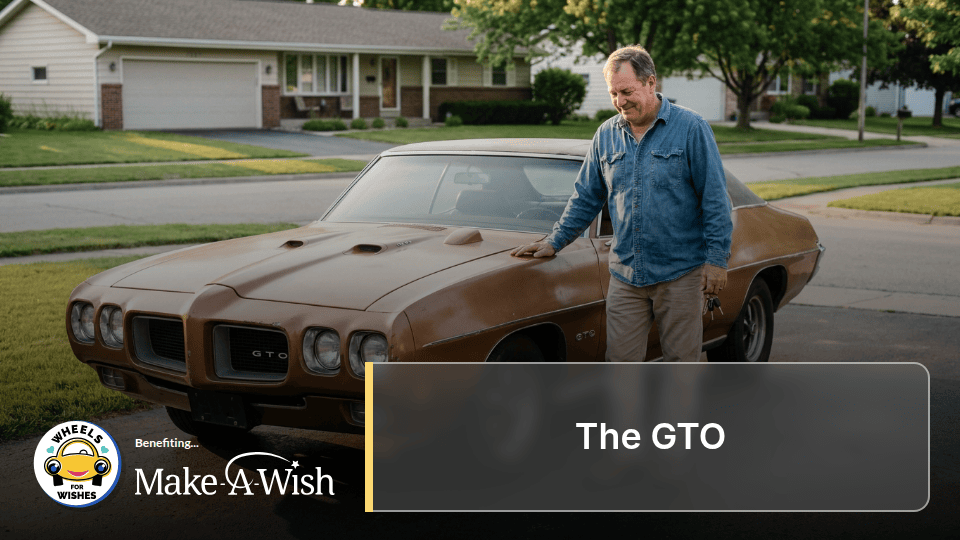
The 1964 Pontiac GTO didn't just launch a model — it launched an era. By stuffing a 389 cubic inch V8 into the midsize Tempest body and calling it the GTO, Pontiac chief engineer John DeLorean created the American muscle car as a concept. Every muscle car that followed — from every manufacturer — owes its existence to that decision.
Original 1964–1974 GTOs are among the most significant American collector vehicles in existence. A Ram Air IV or Judge variant in documented condition generates auction results that can fund a wish entirely on their own. The 2004–2006 GTO revival — built on the Australian Holden Monaro platform with a proper LS V8 and rear-wheel drive — has developed its own devoted following among buyers who appreciate what it was: a genuine muscle car sold without pretense, at a price that honored Pontiac's founding philosophy.
Firebird & Trans Am

The Firebird arrived in 1967 as Pontiac's answer to the Mustang — and promptly became something more culturally significant than any pony car had a right to be. By the time Burt Reynolds slid a black and gold Trans Am across America's screens in 1977, the car had transcended automotive culture entirely.
Second generation Trans Ams — particularly the 1977–1981 "Bandit" cars with their screaming chicken hood decal and 6.6-liter engines — are legitimate American icons that command serious collector prices. The 400 and 455 cubic inch engines that powered first and second generation Firebirds attract buyers who want the real thing, and those buyers bid accordingly.
Third and fourth generation Firebirds and Trans Ams maintain strong enthusiast communities that actively pursue clean examples — Formula and WS6 variants especially. Even the final fourth generation cars produced through 2002 find buyers who recognize them as the last expression of a lineage that started something important.
A Note on Condition
Firebirds and GTOs in any condition attract attention at auction. Running examples find enthusiast buyers. Project cars find restorers. And vehicles that have truly reached the end of the road still carry parts value that generates meaningful proceeds for local children. We welcome older vehicles — here's what to know before you donate.
Grand Prix & Bonneville
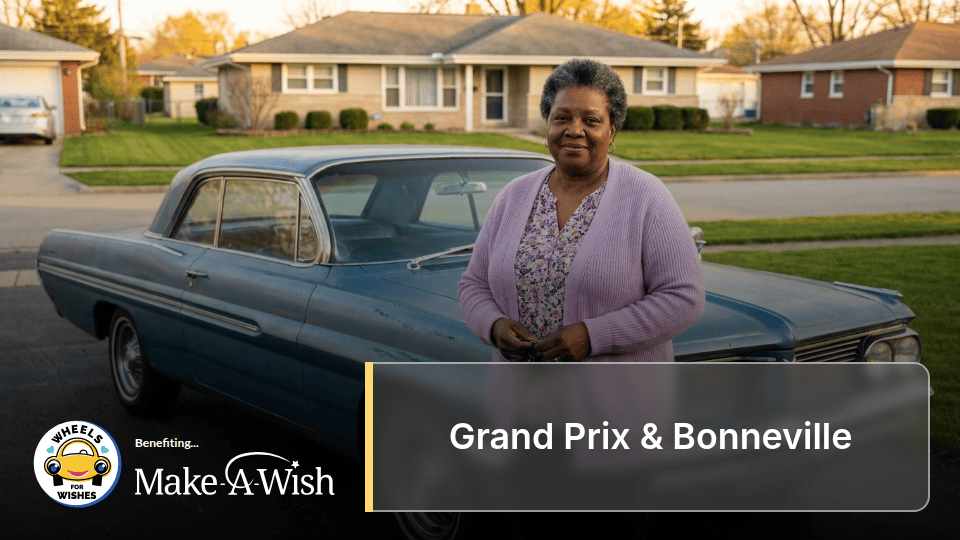
The Grand Prix and Bonneville carried Pontiac's performance spirit into the family sedan segment — vehicles that made no apologies for going fast while carrying four adults in genuine comfort.
The Grand Prix's long production history — from its 1962 debut as a personal luxury coupe through its final generation as a front-wheel-drive sport sedan — created generations of loyal owners. Later Grand Prix GTP models with their supercharged V6 and sport suspension delivered the kind of enthusiastic performance that buyers still specifically hunt for at auction. The Bonneville's SSEi supercharged trim remains one of the more underrated American performance sedans of its era — smooth, powerful, and built with the kind of interior quality that still impresses.
Both models find steady auction buyers who want proven, characterful American transportation at practical prices — and both generate proceeds that benefit local Make-A-Wish kids in ways that honor the vehicles' practical, accessible spirit.
The G8 — Pontiac's Farewell Flagship

If there is one Pontiac that buyers mourn most deeply, it is the G8. Arriving for 2008 and 2009 — just as GM's bankruptcy made its discontinuation inevitable — the G8 was a rear-wheel-drive performance sedan built on the Australian Holden Commodore platform, available with a 6.0-liter LS V8, and everything that American performance sedan buyers had been asking for from Detroit for decades.
It arrived. It impressed everyone who drove it. And it was gone in two model years.
G8 GT and GXP variants have appreciated steadily as buyers who missed them the first time around pursue clean examples with genuine urgency. A well-maintained G8 GXP — with its 415-horsepower LS3 V8 and available six-speed manual — generates auction results that consistently exceed what donors expect. These are not simply old cars. They are the final, fully realized expression of what Pontiac always promised — and the market values them accordingly.
G6 & Vibe — Reliable and Ready

The G6 and Vibe represent Pontiac's practical side — vehicles that delivered solid, dependable transportation with the brand's characteristic style and without demanding heroic maintenance budgets.
The G6 mid-size sedan and coupe drew buyers who wanted a composed, comfortable daily driver with Pontiac's design sensibility. Convertible variants added open-air character that attracted a devoted following — and GXP trims with their V6 power brought genuine driving enthusiasm to what might otherwise have been a conventional family sedan. These vehicles find practical buyers at auction who want reliable transportation at accessible used-car prices.
The Vibe — Pontiac's compact hatchback developed jointly with Toyota — carries a reliability reputation that genuinely surprises people who don't know its history. Built on the Toyota Matrix platform and sharing its powertrain, the Vibe combined Pontiac's styling with Toyota's legendary mechanical dependability. A well-maintained Vibe attracts buyers who specifically seek out its unusual combination of practicality and long-term reliability — and those buyers generate proceeds that benefit local children in ways that honor the Vibe's sensible, hardworking character.
Classic Pontiac Models
The Muscle Car Era — Tempest, Le Mans & GTO Lineage

The Tempest and Le Mans were the platforms that made the GTO possible — and in their own right, they attracted buyers who wanted Pontiac's style and available V8 performance in a lighter, more nimble package. Sprint variants with their overhead cam six-cylinder engine were genuine driver's cars that occupy an interesting collector niche today.
The 1969 Trans Am — the original, produced in just 697 examples its first year — is one of the rarest and most valuable American performance cars in existence. A documented first-year Trans Am would be among the most significant vehicle donations Wheels For Wishes has ever received.
Catalina, Star Chief & Full-Size Classics

The full-size Pontiacs of the late 1950s and 1960s carry genuine collector appeal — their combination of dramatic styling, available Tri-Power V8 configurations, and sheer American scale attract buyers whose passion for this era of Detroit engineering runs deep. The 1959 Wide-Track Pontiacs — with their distinctive wide stance and clean, elegant lines — are increasingly recognized as design masterpieces of their moment.
The Fiero

The Fiero deserves its own moment. Pontiac's mid-engine sports car — the first American production mid-engine vehicle since the Corvair — arrived in 1984 and created a devoted community that still exists in full force today. GT and Formula variants with the 2.8-liter V6 attract enthusiast buyers who appreciate the Fiero's unique engineering. A well-maintained Fiero finds a dedicated buyer quickly — and that buyer's enthusiasm generates auction results that reflect genuine passion for what the car represented.
We evaluate every vehicle on a case-by-case basis — and Pontiac's discontinued status means the vehicles that remain are increasingly valued by a community that refuses to let the brand be forgotten.
How to Donate Your Pontiac in Three Steps
Step One: Call us at 1-855-278-9474 or fill out our car donation form. We accept most Pontiacs in most conditions on a case-by-case basis — our team is happy to answer any questions about your specific vehicle.
Step Two: We arrange free pickup at your convenience, wherever your Pontiac is located — garage, driveway, or storage. We come to you.
Step Three: After your vehicle sells, we'll send your tax-deductible receipt reflecting the final sale value. You'll know your Pontiac's last ride went somewhere genuinely worthy of it.
Pontiac Donation Value & Your Tax Deduction
Your deduction reflects what your Pontiac sells for at auction. When your vehicle sells for more than $500, your deduction reflects that final sale price, and we provide IRS Form 1098-C with everything needed at tax time. If your vehicle sells for under $500, you may be able to claim fair market value up to that amount.
Pontiac's discontinued status works in your favor at auction — a fixed supply meeting consistent demand from a passionate ownership community that isn't going anywhere. Performance models, classic muscle cars, and even practical G6 and Vibe donations all find motivated buyers whose enthusiasm for the brand translates directly into proceeds for local Make-A-Wish kids.
What Your Pontiac Donation Makes Possible
A well-maintained G6 or Vibe typically brings $1,500–$5,000 at auction. A Grand Prix GTP, Bonneville SSEi, or G8 GT can range from $4,000–$15,000 depending on condition. A G8 GXP or clean fourth-generation Trans Am WS6 pushes well beyond those figures. A documented original GTO, first-generation Firebird, or first-year Trans Am with the right collector in the room can generate proceeds that fund a wish experience entirely on their own.
Even a high-mileage Pontiac that has given everything it had still carries the brand's character — and that character has genuine value.
Wheels For Wishes has helped grant 14,673 wishes for local children — dream trips, bedroom transformations, once-in-a-lifetime meetings with favorite athletes, and moments that reminded kids facing critical illnesses that there is still so much ahead of them.
Pontiac spent over 80 years giving Americans something to be excited about. Your donation gives it one final moment to do exactly that — for a child who deserves something wonderful, in a community that cares.
That's a last ride worth taking.
Donate your Pontiac today or call 1-855-278-9474 — we're ready when you are.